

Printer Support Practice: Compare Text Without Changing Files
2026-11-02
Printer Support Practice: Compare Text Without Changing Files
Text comparison can help a printer-support reader ask what differs between two prepared documents. It does not, by itself, show which settings a printer used or why a print behaved differently. This article proposes a read-only exercise with instructor-supplied text. No files were compared, no patch was generated, and no configuration was uploaded to a device. The aim is to describe a textual difference without silently turning it into a repair finding.
Keep the original inputs outside the editing task
Imagine a class supplied with two authorized copies of explanatory configuration text. First state what each copy represents. A file described as a proposed arrangement should not be treated as an observed export from a printer. Its role belongs beside its name throughout the comparison.
Preserve both originals and plan the comparison as a separate reading activity. The learner should not edit one input until it resembles the other merely to make a clean-looking result. An exercise about differences needs the original distinction available for another reader.
The instructor should also define what the comparison is intended to answer. Looking for textual changes is narrower than deciding which document is correct or which configuration a machine actually ran. Keep those later questions visible rather than treating them as automatic outcomes of a diff.
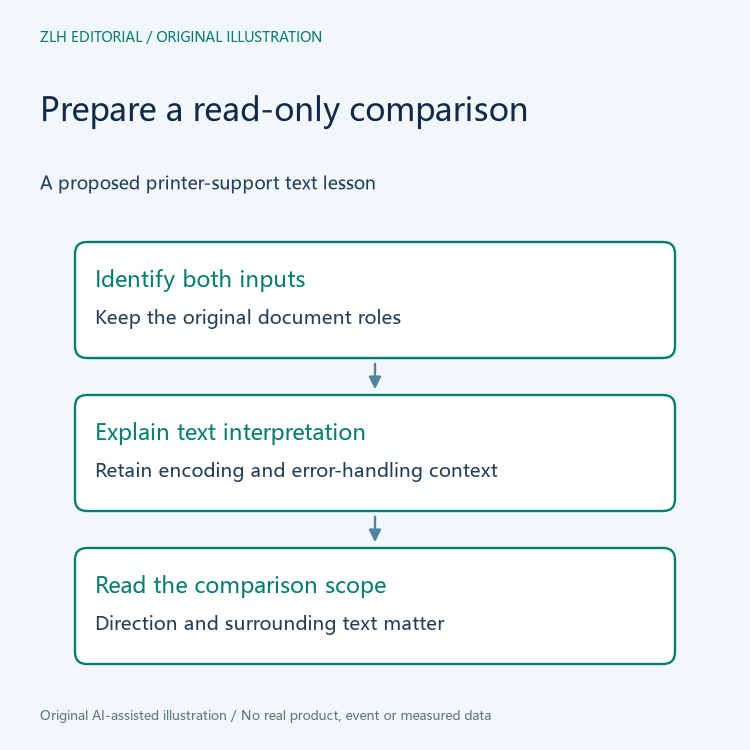
Explain how bytes become the text being compared
The Python Unicode HOWTO describes decoding bytes with an encoding and an error-handling choice. These choices matter to a text-reading exercise because the displayed characters depend on how input is interpreted.
For prepared teaching material, retain the stated encoding context and do not silently discard undecodable content. If interpretation fails or is unknown, ask the instructor to clarify the input. Replacing or ignoring characters merely to obtain a comparison could remove information relevant to the question.
This article supplies no decoding result and chooses no encoding for an unknown file. It identifies a prerequisite that a later authorized exercise must explain. A successful-looking display would not prove that the original bytes were interpreted as their author intended.
Read a diff as a presentation of differences
The difflib documentation describes unified_diff as comparing lists of strings and presenting changed lines with surrounding context. A learner can use that description to understand the purpose of such a view before examining a prepared output.
Keep the comparison direction and input identities explicit. A reader should know which prepared input occupies each side. The layout is part of interpreting the report; it is not a reason to relabel one file as the accepted configuration without an independent decision.
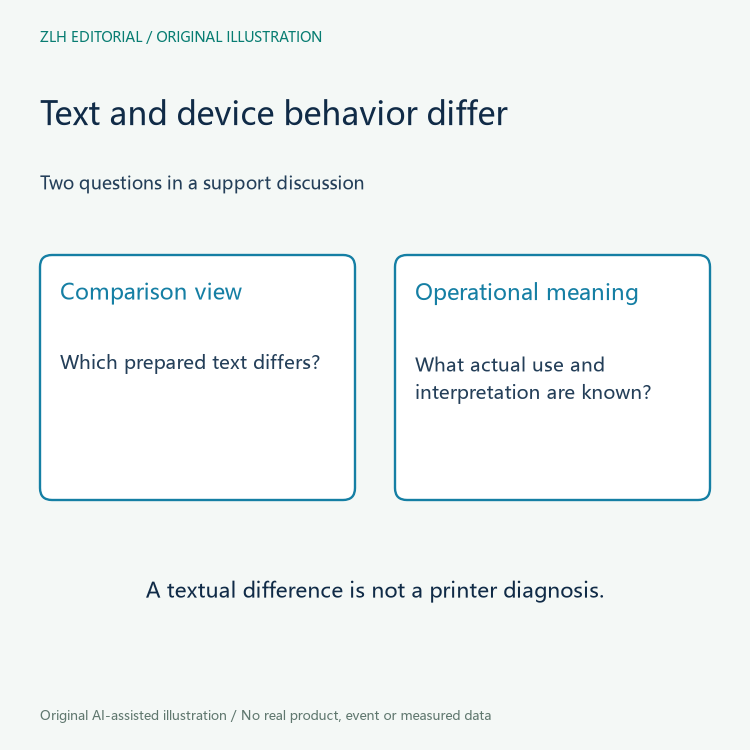
A compact view also has a selected amount of context. Ask whether the surrounding text needed to understand a changed line is available. Do not treat a short excerpt as proof that every unshown section was examined for meaning.
Separate character changes from operational meaning
A textual difference may raise a useful support question, but its operational meaning depends on the relevant software, configuration interpretation, and actual use. The proposed lesson does not establish any of those for a real printer. A changed word should not become a claimed change in temperature, motion, or output quality.
Ask the learner to write one statement about text and a separate question about interpretation. This makes the boundary easy to review. A colleague can then identify what a software owner or equipment provider would need to explain before a broader conclusion could be considered.
The exercise should not apply a patch or copy a prepared value into production. Its purpose is reading. Any later change to an operating system would need its own authorization and understanding of the device context, rather than follow automatically from a classroom comparison.
Leave a comparison another reader can understand
The teaching summary should retain the identities of the prepared inputs, the stated text interpretation, the comparison direction, and the scope actually discussed. Keep unresolved interpretation questions beside the relevant source material for later discussion. If no comparison has been performed, describe the plan honestly instead of adding invented changed lines.
Ask a colleague whether they can distinguish a difference in text from a claim about the printer. If the two merge, narrow the wording. A useful support question can remain unresolved while still being precise enough for the appropriate owner to investigate later.
Related material appears in our printer-support reading section and the article directory. The original illustrations describe a reading method, with no real configuration fragments, diff output, measured printer behavior, or completed repair. They do not replace examination of the actual authorized material when such an investigation is required.


