

OctoPrint Repair News: Keep the Handshake Symptom Specific
2026-11-03
OctoPrint Repair News: Keep the Handshake Symptom Specific
A connection problem described in a release note can be a useful lead for printer support, provided the reported symptom remains specific. The latest stable OctoPrint release record checked for this article points to a June repair item concerning a non-responsive serial connection. Its value today is as a dated reference that a support reviewer can compare with an actual observation. It is not proof that every printer which fails to connect has the same cause.
A narrow June fix, revisited with its original date
The official 1.11.8 release, published June 23, 2026, lists a fix for a thread leak when a serial port does not respond to handshake attempts. The linked project issue 5420 preserves the underlying discussion. Those two records connect a reported problem to an upstream release item. This is a review of that existing material, not an announcement that the fix first appeared in November.
For a maintenance writer, the wording matters. A connection attempt, the absence of a response and a resource problem in software are distinct observations. A broad phrase such as printer offline can conceal all of them. Keep the upstream description intact when using it as a support reference, then ask which parts have actually been observed in the case under review.
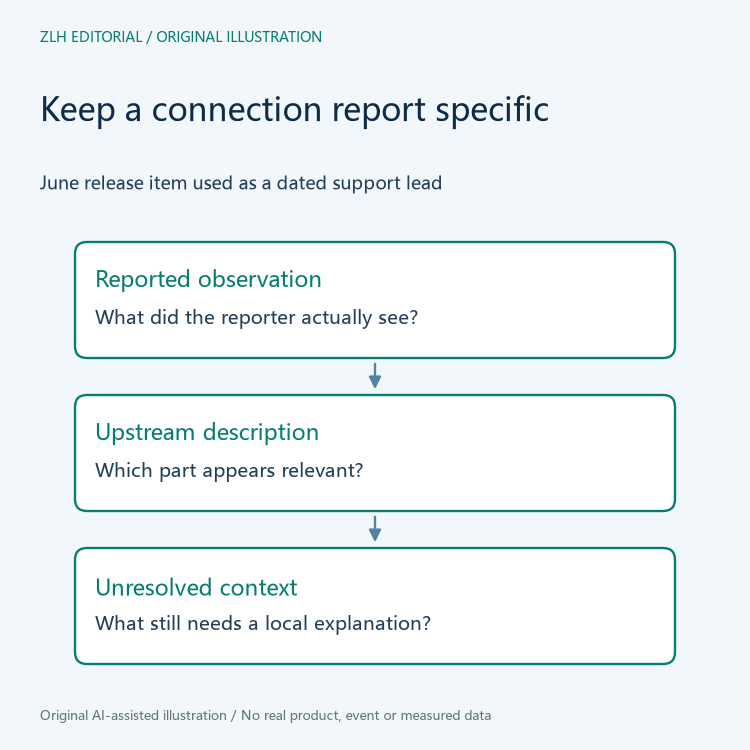
Describe the local symptom before proposing a match
Suppose a hypothetical service request says that a printer did not become available in an interface. The recipient should first ask the reporter to explain what they saw and when. Did the interface report an attempted connection, did it show a specific message, or was the only observation that an expected screen did not change? These questions organize a report; they do not diagnose a physical printer or recommend repeating connection attempts.
A support record can retain the reporter's own words beside a clearer description of the observation. If additional material is supplied later, identify which statement it supports. This is preferable to replacing the original symptom with the wording of a release note before a correspondence has been established. Otherwise the investigation may appear more certain on paper than it actually is.
Keep unavailable information visible as unavailable. If no relevant process observation was collected, the report should not contain an invented thread count. If the software version is unknown, do not infer it from the appearance of a web interface. Accurate gaps let the responsible support person decide what explanation is still needed.
Separate an issue discussion from a current support result
An upstream issue can contain useful context and observations made by its participants. Those remain observations about the circumstances they described. They do not establish that another user's software, plugins and connection conditions are identical. A maintenance article can link the discussion as a lead without copying its narrative into a new service record as if the same events had happened again.
The next useful step in documentation is to state the proposed relationship explicitly: which observation resembles which part of the upstream description, and what remains unconfirmed? The responsible support person can assess that relationship against the actual environment. This article has not collected logs, accessed a printer host or observed a connection, so it supplies no case-specific diagnosis or resolution.

Make any later follow-up answer the original question
If authorized maintenance later produces a result, the follow-up should identify the action and observation actually recorded. A software change and a connection observation should be described separately. Merely writing that a version was updated does not explain what happened to the originally reported symptom. Equally, a later successful connection does not reconstruct every earlier condition that went undocumented.
Keep the chronology understandable to someone who did not participate in the conversation. The original report, proposed lead, support decision and follow-up may be written by different people. Naming the role of each entry helps a reviewer distinguish the reporter's observation from a technician's interpretation and from a subsequent result. It also avoids converting uncertainty into a tidy but unsupported repair story.
Use the release note as a reference, with a bounded conclusion
The documented fix is relevant to a specific class of connection behavior. Its appropriate editorial use is to sharpen a support question, not to prescribe a universal remedy for unavailable printers. The release includes other material that would require separate review before an actual maintenance decision. No update, restart, plugin change or equipment operation was performed for this article.
Our two original illustrations show how to organize a support question without using real logs or customer data. Related articles in the printer service record collection discuss other evidence boundaries, while the article directory provides the broader index. A useful support lead stays attached to its original wording and date until the current case supplies its own evidence.


