

Printer Support Downloads: Names and Media Types Differ
2026-11-04
Printer Support Downloads: Names and Media Types Differ
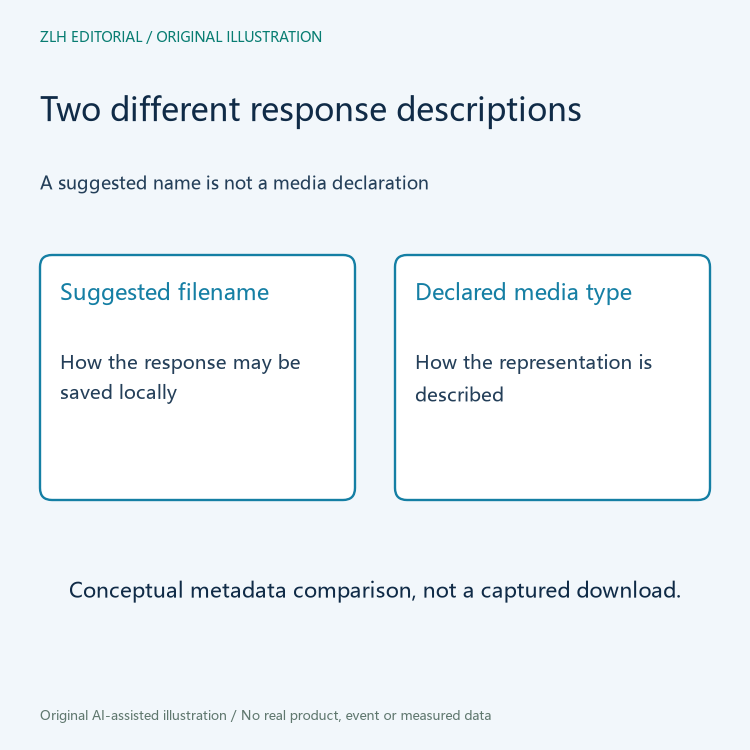
A printer support record may refer to an attachment by the name shown in a download dialog. That name is useful for finding the local file, but it is not a complete description of the HTTP response that delivered it. Two established standards explain separate parts of the exchange: a suggested filename and a declared media type. Reading them together helps a service team describe an attachment without pretending that its name proves its contents or its suitability for a repair task.
The download name is advice about saving a response
RFC 6266 defines the HTTP Content-Disposition field and discusses filename handling. Its guidance treats a supplied filename as advisory. This is an important limit: a name suggested by a server does not become a trustworthy statement about every property of the received file.
In a support note, separate the name presented during retrieval from any local name later assigned by a person or browser. A receiving system might alter a name to fit its own rules or avoid an existing file. If the record contains only the final local name, it may lose the relationship to what the support link originally suggested.
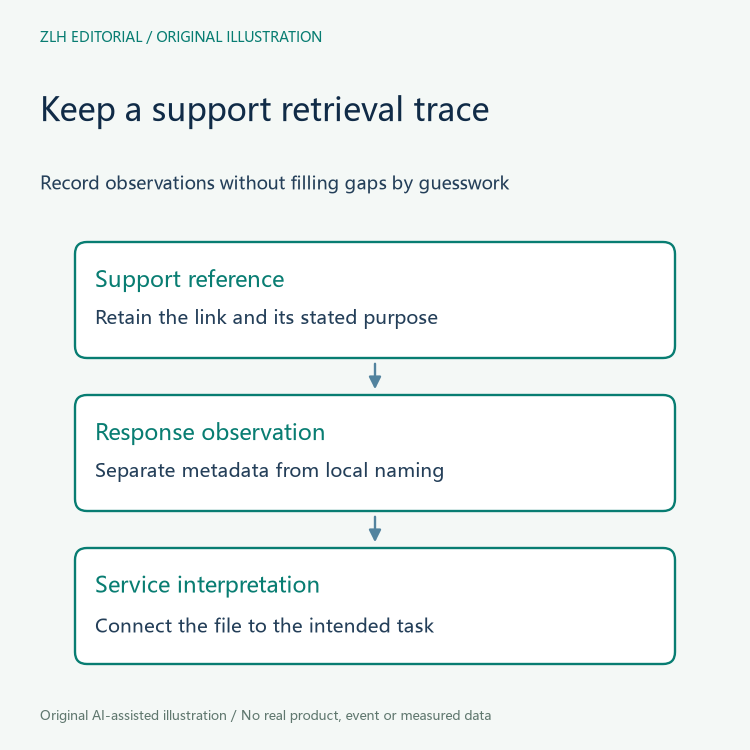
This distinction does not establish that a real printer vendor has mislabeled an attachment. It gives a reviewer a vocabulary for asking what was observed. Preserve the original support reference and retrieval context when those facts are available; do not reconstruct a server-supplied name from memory and present it as a captured response.
The media type describes the associated representation
Section 8.3 of RFC 9110 explains the Content-Type field as the media type of the associated representation. That declared type and a proposed filename have different roles. Reading one field does not amount to reading the other, even when a file extension appears consistent with the declaration.
For a service record, write down an observed media type as response metadata, rather than deriving it from an extension. If no response information was retained, say that it was not captured. A plausible type entered later would conceal a gap in the record and could lead another technician to believe a check took place.
A server declaration is still something to evaluate in context. The standard's explanation of the field does not certify the bytes of a particular attachment, and a familiar type does not establish that a file is safe to open. This article does not recommend automatically executing or previewing received support files.
Describe a disagreement before assigning a cause
Suppose a future support investigation records a filename, a media declaration and an application display that appear inconsistent. Treat that as a hypothetical investigation question, not an incident reported here. The first task would be to identify which observations belong to the same retrieval and which were collected at a later stage.
The response could have involved a redirect, an error page or another representation, but none of those possibilities should be written as the cause without evidence. Keep an observed response status and final retrieval location if the approved support workflow collects them. A technician should not have to guess whether the retained file came from the attachment link or an unrelated browser page.
Use the established security process for suspicious material and leave the original evidence intact. Renaming a file to match an expected extension does not resolve a disagreement about the delivered representation. It also changes what the next reader sees, so any authorized working copy should remain distinguishable from the original.
Keep download evidence separate from printer behavior
An attachment can be retrieved successfully while still being the wrong document for a printer model or software version. Conversely, a retrieval problem does not by itself show that the printer has a hardware fault. The service history should preserve those different questions rather than merging them under a vague note that the support package failed.
Ask which role the attachment plays: background guidance, a diagnostic record or another explicitly identified deliverable. The person authorizing its use should have a basis for connecting it to the intended support task. Neither a filename nor an HTTP media declaration supplies that equipment-specific connection on its own.
Read established standards without inventing a release story
RFC 6266 was published in 2011 and RFC 9110 in 2022. They are cited here as established primary references, not as newly released printer features. A current support discussion can use older standards while keeping their dates and the scope of its own observations clear.
The original diagrams show relationships between record fields; they contain no captured vendor response or actual customer attachment. Related discussions are available in the printer service records collection and the article directory. Precise descriptions of names and media types help preserve what a download record can establish, while leaving file content review and repair conclusions to their own evidence.


