

Printer Service CSV: Read Records Beyond Line Breaks
2026-11-04
Printer Service CSV: Read Records Beyond Line Breaks
A service CSV can look longer in a text viewer than it does in an import preview. Before treating that difference as missing printer history, ask what each viewer is counting. A note containing a line break may occupy several physical lines while remaining one field in one logical record. This reading exercise concerns an attachment's structure. It does not describe an actual printer, a completed import, or an observed repair outcome.
Identify the record question before counting anything
Begin with the service team's question. Are they asking how many cases were exported, how many observations were attached to a case, or how many lines appear in a text window? Those are different objects. A single case might have several observations, and a single observation might include a multiline description. Counting visible lines cannot establish the number of cases without the export's field and record conventions.
For a hypothetical handover, imagine an attachment with fields named case_label, observation and follow_up. The observation contains a short description and a separate paragraph of context. These are invented field names, not a recommendation to alter an existing support system. The useful question is whether the receiving reader preserves that whole observation as one field. A screenshot showing wrapped text is insufficient because display wrapping and stored line breaks also differ.
Read quoting as part of the file format
RFC 4180's format description includes double-quoted fields containing commas or line breaks and doubled quotation marks within quoted fields. It is an informational RFC from October 2005, not a claim that every exporter follows identical rules. Its examples explain why splitting an attachment at every comma or newline can give the wrong picture of its records.
In the fictional observation, a comma between two phrases belongs to the note when the applicable quoting rules keep it there. It is not automatically another column. Likewise, the two quotation marks representing an embedded quote are part of the encoded representation; they are not necessarily two quotes intended for the reader. Preserve a small, nonconfidential excerpt when explaining this distinction. Describe the quoted boundary in words rather than silently rewriting the original attachment into a tidier looking version.
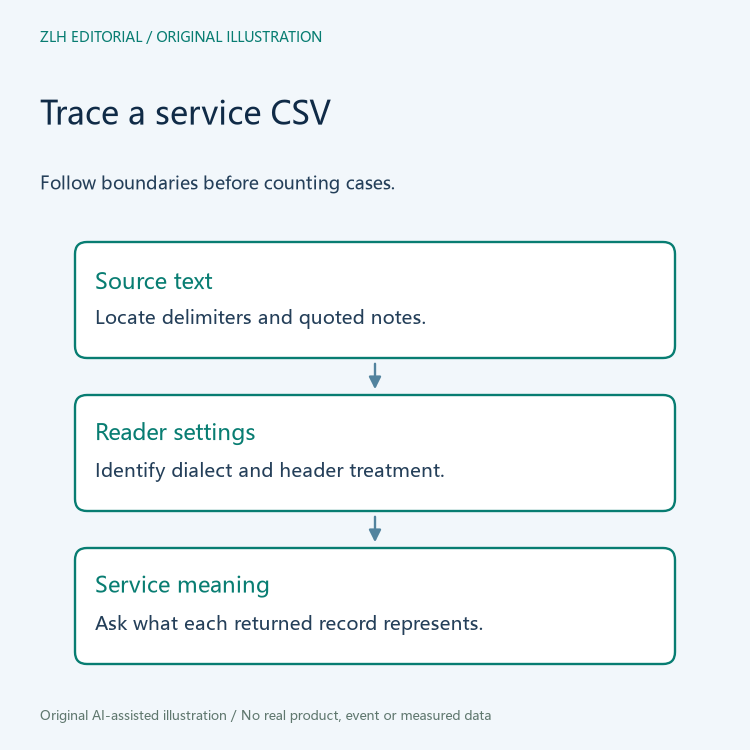
Keep the reader's dialect and header choice visible
The Python csv reference documents configurable dialect and formatting parameters. It also distinguishes a reader's consumed source lines from returned records, which can span multiple lines. Its DictReader documentation explains that an omitted fieldnames argument uses the first row as names, while explicitly supplied names leave that first row in the returned data. These are software behaviors to read in context, not evidence that an unspecified service export was parsed correctly.
A handover should therefore identify the intended delimiter, quote convention and header treatment. Merely saying that the attachment is CSV leaves room for different interpretations. If a recipient says the first service entry disappeared, establish whether it was an actual case record or a header used as field names. Do not infer deletion from the difference alone. Ask for the reader's reported interpretation and an attributable description of the expected layout before making a new version.
Describe an apparent row mismatch without diagnosing it
Suppose, hypothetically, that a support coordinator sees a continuation paragraph on another line while the import preview keeps it beside the same case label. The initial finding can say that the two views present boundaries differently. It should not say that the database lost an entry or that the printer generated a corrupt log. Neither conclusion follows from those views. Keep the source excerpt and the preview together, showing which text belongs to the proposed record.
Also distinguish extra fields from empty fields. A comma at a field boundary can matter even when no text appears between neighboring delimiters. Removing punctuation to make the file readable may change the question under review. If the export's conventions are unavailable, label the interpretation unresolved. A useful follow-up request asks the exporter to confirm the field layout and treatment of multiline observations, with a harmless example rather than a customer's complete service history.
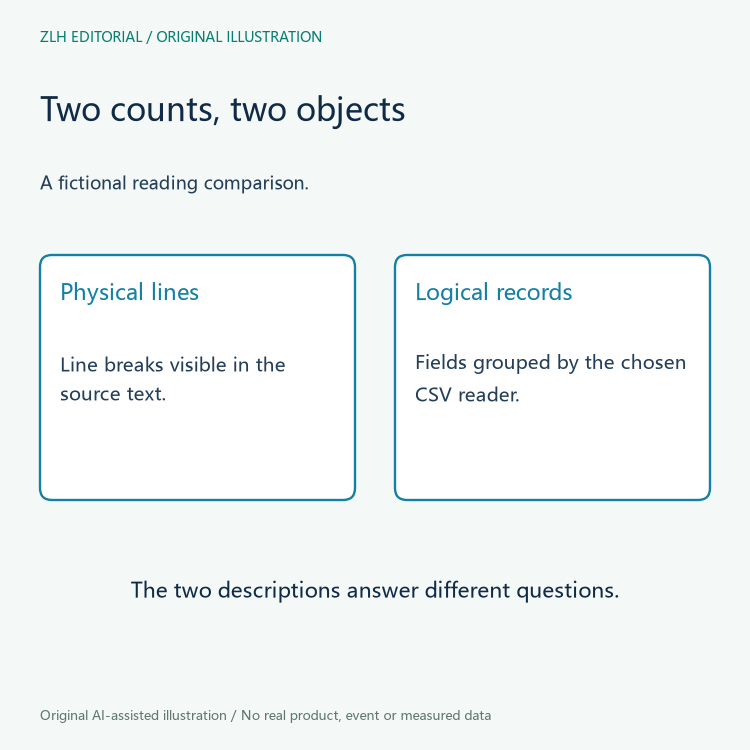
Write a handover that preserves both structure and meaning
The service handover can separate three statements: what the original bytes display as text, how a named reader interpreted the boundaries, and what the service owner says the fields mean. The first is an attachment observation; the second belongs to software behavior; the third supplies business meaning. When those statements disagree, keep all of them visible. A structurally readable observation can still contain an incorrect description of the printer, so successful reading does not validate the diagnosis.
For a later revision, retain the original attachment and describe which convention changed, who supplied the clarification and which receiving view still needs checking. Avoid claiming that a repaired export proves the underlying service case is resolved. The practical result sought here is a record whose paragraphs and columns can be explained consistently. Readers can continue through our technical information category or the related resources category when exploring other documentation questions; these category links do not identify a particular published case.


