

Printer Service Photos: Read Palette Index and RGB Values
2026-11-04
Printer Service Photos: Read Palette Index and RGB Values
A palette index in a printer service image is not the same object as an RGB colour value. A pixel reading needs its image mode and any palette mapping before a reviewer can explain what the value represents. Without that context, a small integer can be mistaken for a direct brightness or colour measurement. This article uses fictional image records and official Pillow documentation; it does not inspect a real photograph, change an image or diagnose a printer.
Identify the image mode behind a reported pixel
Imagine a fictional support pack containing a compact annotated image and a note that cites a single pixel value. The note does not say how that value was obtained. The reviewer should ask which image object and mode were read, rather than assuming every image stores a red, green and blue tuple at each location. A screenshot's visible colour does not explain the representation used by a separate pixel-reading tool.
Keep the exact file reference with the provider's reading explanation. A thumbnail, an annotated derivative and an original photograph can have different representations. Do not transfer a numeric note from one to another merely because they show the same printer feature. The documentation needs to identify where the reported value came from before it can explain how that value relates to visible colour.
Read palette mode as an indexed representation
The Pillow concepts documentation describes P mode as pixels mapped to another mode through a colour palette, while RGB mode uses red, green and blue bands. It also explains that the palette defines actual colours for palette-mode pixels. This is a representation distinction, not a claim that any particular service image uses one mode or another.
For the fictional pack, an index identifies an entry in the relevant palette. The reviewer should request that palette relationship before interpreting the index as colour. A larger index should not be narrated as a brighter defect without an appropriate explanation. The meaning comes from the representation and mapping, not from the apparent magnitude of an integer written in a maintenance note.
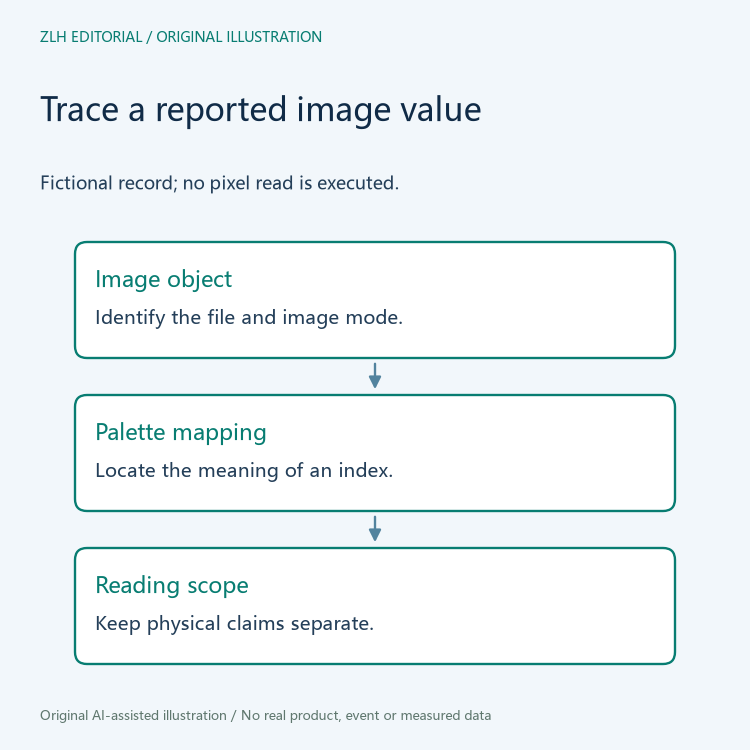
Read the pixel and palette methods together
The official Pillow Image reference documents getpixel as returning the value at an image position and getpalette as returning palette data where applicable. The same reference describes image mode and conversion methods. These are tool capabilities; their presence in documentation does not prove that a provider read the correct file or recorded the corresponding palette.
A useful fictional handover can name the method, file and mode, then preserve the palette information needed to explain an indexed value. It should distinguish a recorded reading from example code in a manual. This article executes no pixel read and computes no colour tuple. It therefore has no example result that could be mistaken for a measured feature on an actual print or machine component.
Keep converted copies and colour claims separate
If the fictional provider supplies a converted RGB copy, retain the relationship between that copy and the indexed source. A representation conversion should have its own record. Do not describe the index from one object and an RGB tuple from another as identical kinds of observations, even when the provider intends them to refer to the same visible location. The relevant mapping and object relationship still need explanation.
Nor does a colour representation establish a physical cause. Lighting, capture conditions and image processing may be relevant questions for a real photo review, but this article has not observed those conditions. A maintenance note should avoid turning a pixel value into a conclusion about heat, contamination or material quality. Those explanations require evidence appropriate to the claim, beyond identifying the image's mode.
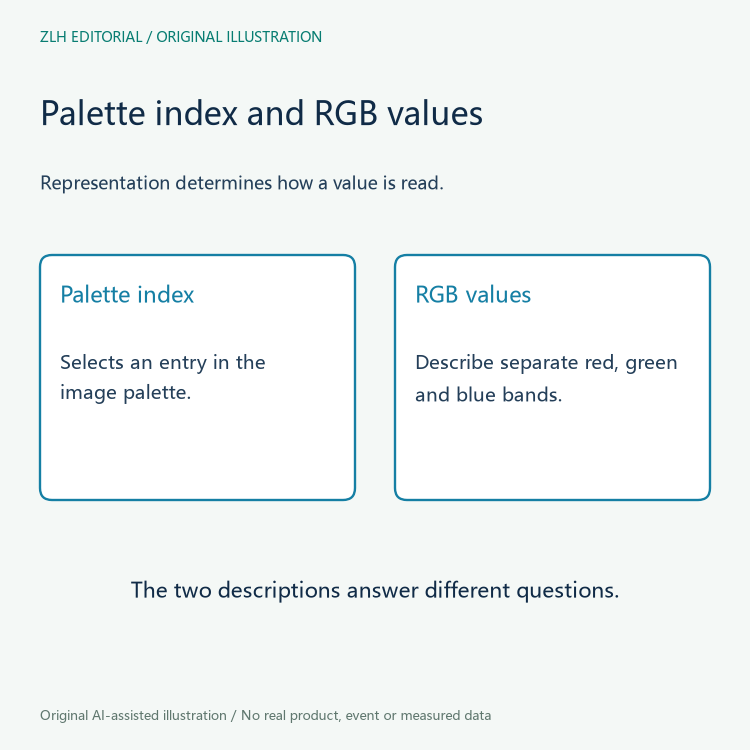
Write the finding around the representation actually read
A clear finding can identify the file, mode, pixel-reading explanation and palette mapping supplied. It should say whether a converted copy was also provided and which object an annotation refers to. If the palette or file relationship is missing, preserve that as an unresolved question. Do not fill the gap with a plausible colour name inferred from a preview or from another attachment.
The record should also identify which statements came from the provider and which were directly reviewed. A later editor can then ask for the missing representation details without reconstructing the entire support exchange. This is a documentation outcome, not an image-authenticity assessment or a repair result. The fictional diagrams deliberately contain no colour samples claimed to come from a printer.
Further methods are organised in the technical material category and related resource category. These category entrances do not evaluate service photographs. Keeping index values, palette mapping and RGB representation distinct makes the next technical conversation more precise and leaves the physical explanation with its own evidence.


