

Printer Service Date FAQ: ISO Week-Year and Calendar Year
2026-11-05
Printer Service Date FAQ: ISO Week-Year and Calendar Year
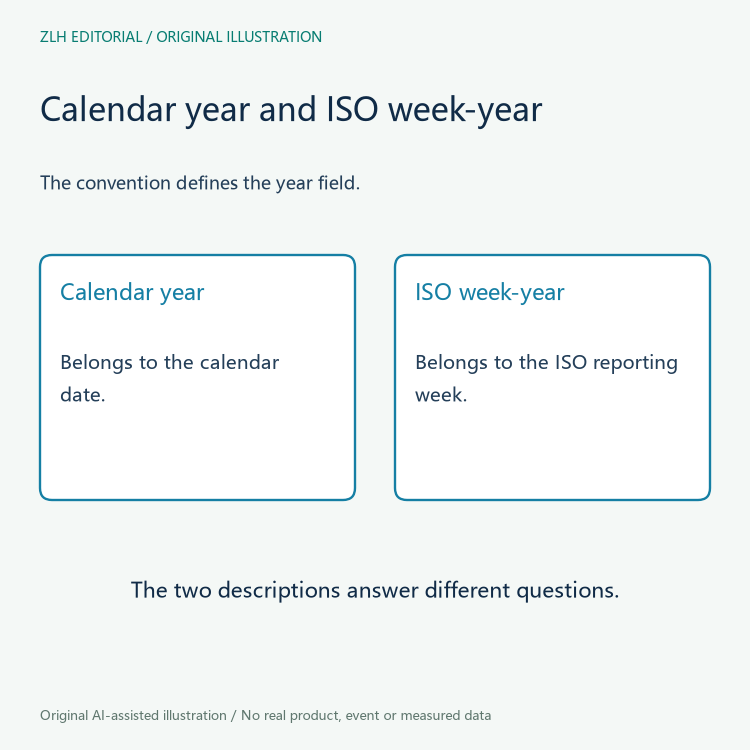
ISO week-year and calendar year can identify different year values for the same date near a year boundary. A printer service export should name the convention before a reviewer treats that difference as a missing record or a changed event date. This FAQ reads official Python documentation using a fictional service archive. It does not parse an actual export, calculate dates or verify when a printer was repaired.
Why can a weekly label disagree with a date's year?
The Python datetime format reference distinguishes the calendar-year directive from the ISO week-year directive. It explicitly says they are not interchangeable. A weekly label belongs to a week-based convention, while an ordinary date includes its calendar year. The difference in representation is a reason to inspect the formatting rule, rather than immediately changing an event record.
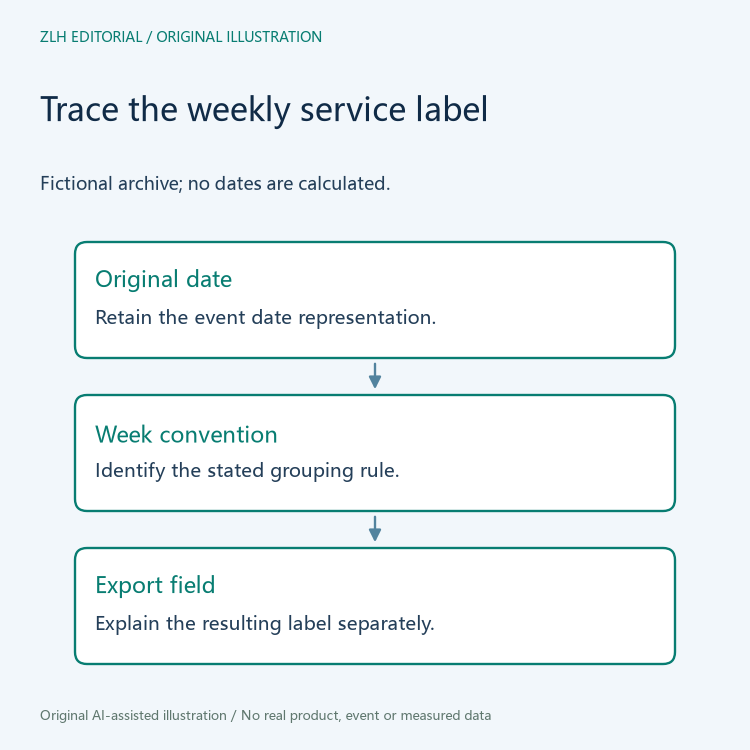
Imagine a fictional archive with a service date and a weekly folder label. A reviewer notices a boundary-related difference but has only the displayed strings. The useful request is for the original date and the rule that produced the weekly label. Do not silently replace one year with the other. The archive needs to preserve whether the field locates an event date or groups records into a reporting week.
Which week convention does the exporter actually use?
The official time.strftime reference defines the ISO week as starting on Monday, with the first week containing the year's first Thursday. It also documents other week-number conventions. A field described only as week number is therefore incomplete for review. Ask the provider to identify its convention rather than assuming every week-based folder follows the same rule.
For the fictional service pack, preserve the full field names and any accompanying weekday information. A week number alone does not locate a unique date, and a year value alone does not explain the intended week convention. This article gives no computed boundary-date example because no conversion has been run. Its purpose is to identify the pieces of the representation that another reviewer would need to reproduce or assess the exporter.
Does this difference prove that a service event moved?
No conclusion about an event moving follows solely from two differently defined year fields. The fictional archive should retain the event's source date and any provider explanation of grouping. If the actual event date was revised, that needs its own revision record. If only a display rule changed, the maintenance note should identify that rule instead of narrating a rescheduled visit that has not been documented.
Likewise, an apparent match does not prove that two fields mean the same thing throughout the archive. Many dates can have matching year values under both conventions. The reviewer should examine the declared rule, not infer the whole schema from a convenient displayed row. This is a documentation question and does not require inventing printer usage, maintenance intervals or a technician's actions.
What should accompany a formatting explanation?
Keep the original input representation, the format description, the relevant software version and the meaning of the output field. The datetime reference also notes platform variation in supported formatting codes. A provider's actual environment therefore matters if a report makes claims about generated output. Reading a manual is not evidence that a particular export tool produced or accepted a specific string.
Suppose the fictional provider supplies a clarification after an ambiguous folder label was questioned. Append it with the version of the archive it explains. Preserve the earlier label and the original date rather than making a correction that erases the reason for the question. A later maintainer can then distinguish an interpretation change from an actual change in the service-event record.
How can the FAQ state a bounded finding?
A clear finding names calendar date, reporting week, week-year and the supplied conversion rule as distinct items. It identifies any missing source date or unspecified convention. It should not claim that a service was missed, duplicated or completed merely because a weekly label looks unfamiliar. This article has checked no printer history and reports no repaired chronology, date conversion result or observed export behaviour.
An illustration can show the relation between input date and reporting label, provided it remains conceptual. Avoid adding an invented dated work order to make the diagram appear realistic. The evidence should come from the archive when it is available, and the diagram should only guide a reviewer toward the fields whose meanings need explanation.
Further methods appear in the technical material category and related resource category. These category entrances do not authenticate service records. Keeping ISO week-year and calendar year attached to their own conventions gives a printer service date review a precise question and preserves the underlying chronology for actual evidence-based checking.


