

Printer Service Files: Read Binary G-code Before Text
2026-11-05
Printer Service Files: Read Binary G-code Before Text
Binary G-code in a printer service attachment needs to be identified as a structured file before its bytes are judged through a text-editor view. Unfamiliar characters in that view do not, by themselves, establish a damaged print instruction or a printer fault. The useful first question concerns the representation actually supplied. This article reads Prusa documentation and the libbgcode specification through a hypothetical service pack. It neither opens an actual job file nor converts, uploads or executes printer instructions.
What is the documentation describing as binary?
The official Prusa Binary G-code knowledge-base article describes encoding and compression of ASCII G-code using a format with individually handled blocks. It also distinguishes slicer support from firmware support. The page appears within a PrusaSlicer 2.9 legacy topic context when read. Its existence does not establish which software created a particular attachment or which firmware a service customer's machine contains.
For a hypothetical service file, retain the submitted name, the contributor's stated format and any producing-software record. A filename suffix is a useful supplied label, but it should not replace the format evidence. Likewise, a text editor's display is an observation about that editor's interpretation. If the file is described as binary, a screenshot of unusual characters asks for a format explanation rather than immediately proving that a nozzle, controller or storage device failed.
How does the block specification organize the file?
The libbgcode specification on its main branch describes a file header followed by an ordered sequence of blocks. These include printer metadata, print metadata, slicer metadata and G-code data, with optional file metadata and thumbnail blocks. Its header identifies the binarization version, with the inspected document stating version one. The branch can change, so the retained source snapshot matters when explaining a historical attachment.
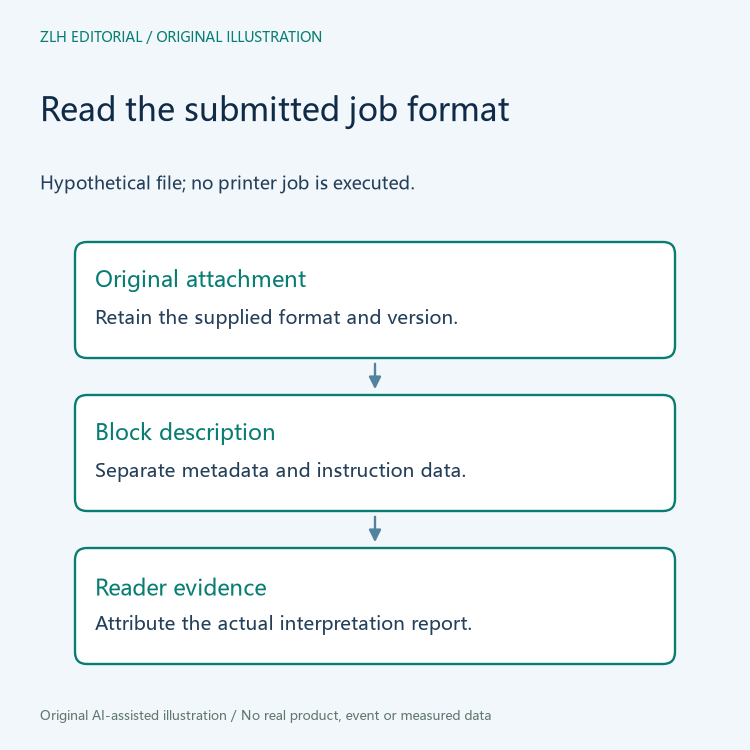
A service note should keep these roles distinguishable. An embedded thumbnail is not the G-code data block, and slicer metadata is not a separate observation that the printer performed the described job. The diagram here maps documentation objects without inventing an actual block inventory. If a provider supplies a decoded report, ask which reader and format version produced it and retain the original attachment separately from that report.
Are encoding and compression the same field?
The specification places compression information in the block header and gives block types their own parameters. In the GCode block description, encoding is a separate parameter. These are related parts of interpreting the stored content, rather than two interchangeable names for one setting. A report that records only compressed may omit information needed to explain how the G-code data is represented.
For the hypothetical pack, a useful request names the file version, block type and the declared interpretation. It does not ask the service editor to guess a decoder from a screenshot. No compression ratio has been measured here, and the manufacturer's general size-reduction statement is not a result for this pack. A compact file should not be presented as proof that a print will finish faster or that a transfer completed correctly.
What do metadata and thumbnails establish?
The specification describes printer metadata as key-value information consumed by the printer, and print metadata as information such as print time or material consumption. It separately defines thumbnail image data. Those descriptions locate the fields; they do not tell a service reviewer whether a reported quantity was planned, measured or later edited in an actual workflow. The contributor should explain the provenance of any value used as evidence.
Suppose the hypothetical pack contains a preview image and a duration label. The reviewer can ask where each came from and what it was intended to communicate. Do not treat the preview as a photograph of a printed part, or the metadata label as a stopwatch record. If a later attachment supplies an actual observation, connect it explicitly to the source job rather than letting two familiar labels silently stand for the same event.
The specification also makes checksum presence depend on the file header's declared checksum type. A service summary should therefore distinguish an optional checksum field from an observed verification result. This article performs no checksum computation and makes no integrity finding about a file. The appropriate evidence would identify the actual object checked, the method and its result, with any uncertainty still visible.

How should the service handover close this question?
A bounded handover can state the format claimed by the contributor, the retained original file, the relevant specification snapshot and any supplied reader report. It should list unresolved producing-software or firmware context separately. The source article's support statements are not a compatibility assurance for an unknown printer or third-party control program. Neither successful decoding nor a familiar extension establishes that a real print task is suitable.
When a contributor provides a converted copy, preserve its relationship to the original and identify the claimed conversion process. This article prescribes no conversion commands. A replacement should not erase the earlier evidence or make a text-view observation appear to have concerned different bytes. Keeping the representations traceable allows the service team to investigate the actual report without manufacturing a printer diagnosis from file appearance.
Related methods appear in the printer technical-material category and related resource category. Both illustrations are original conceptual reading aids without real blocks or print results. Reading binary G-code as a declared container gives a service reviewer a specific format question and keeps operational conclusions attached to the evidence that can support them.


