

Printer Service Handover: Stored and Reported Settings
2026-11-05
Printer Service Handover: Stored and Reported Settings
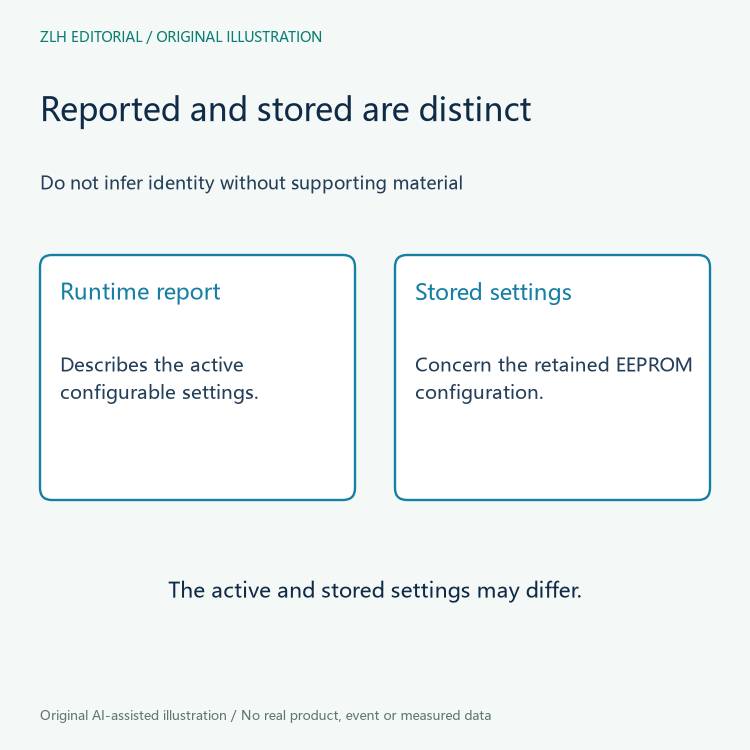
A Settings report in a printer service handover describes an identifiable piece of evidence, but it should not automatically be called a record of stored configuration. Marlin distinguishes active runtime settings from settings saved to EEPROM. Its documentation explicitly notes that the two may differ. A recipient can read a supplied report correctly while still needing information about persistence. This article explains that document boundary without connecting to a printer, sending a command or changing any settings.
Read the runtime report according to its own description
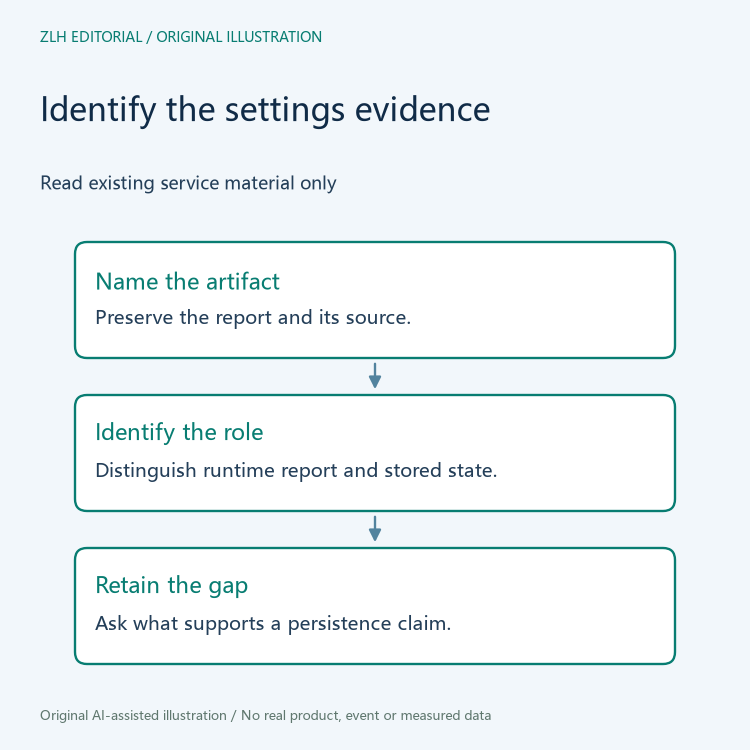
The official M503 Report Settings documentation describes a concise report of runtime-configurable settings held in SRAM. It says that the active settings may or may not match those stored in EEPROM. That qualification is central to a service record. A saved text file containing an active-settings report does not, through its filename alone, establish what the printer retained in nonvolatile storage.
For an existing submission, retain the report's identity, source and stated collection context. If the contributor only supplies an excerpt, say which portion is available. A label such as configuration backup may be convenient, but the reviewer should ask what the file actually contains before repeating that label. The question concerns the evidence supplied, not an instruction to recollect data on a live printer.
Keep the save function separate from the evidence of a save
The official M500 Save Settings documentation describes saving configurable settings to EEPROM and identifies its firmware feature context. Reading this definition explains the purpose of the save operation. It does not show that the operation occurred on an unknown device, when it occurred or which active settings were involved. A persistence statement in a handover needs its own supporting account.
Imagine a fictional service pack containing only a settings report, with a summary saying that every reported value is confirmed stored. The useful response is to request the basis for the storage claim. The report may still be useful; the unsupported part is the additional conclusion. This invented example contains no real printer, configuration values or failed save result, and it offers no save or reset procedure.
Do not let a familiar command name erase option scope
The M503 page also documents a C option, associated with configuration embedding since Marlin 2.0.9.3, that saves an embedded configuration ZIP to SD card or flash drive. That is a separately described artifact role. A reviewer should therefore avoid saying that every possible invocation associated with the page can only produce a console report. The exact option and resulting object matter to an interpretation.
An embedded configuration archive and an active-settings report should retain their distinct names in the service inventory. Neither should be silently substituted for a claim about the currently stored runtime configuration. This article does not explain how to invoke the option or create the archive. It uses the documented distinction to show why an artifact description should remain more specific than a command family name.
Preserve the relationship between the file and the device
A report can be copied, renamed or forwarded without changing the printer. A handover should preserve which machine the contributor associates with it and what observation period or collection event is stated. If that relationship is missing, a matching model name is not enough to fill it in. Retain the original material and request the information needed to connect it to the service question.
A second fictional example might include two reports from different service stages but no explanation of their relationship. A difference between them could be recorded as a document difference. It should not immediately become a finding that stored settings were lost or that hardware failed. The actual sequence and storage context remain questions for the responsible service team and the available evidence.
Close the handover with a bounded persistence question
A clear service note can say that the active-settings report has been identified, that the storage claim is supported by a named record, or that the connection remains unresolved. These are reviewable statements. They do not require calling every supplied file a complete backup or declaring that a printer has been restored. A document-reading result should describe the question it actually resolves.
The Marlin pages were read on November 5, 2026. Their documented feature and option conditions should stay with any explanation, while the actual firmware version belongs in the device's own record. The illustrations are original conceptual aids with no real settings, memory contents or machine likeness. Related reading is available in the printer service evidence collection and article directory. Keeping Settings reports separate from persistence evidence gives the next reviewer a precise starting point.


