

Printer Arc Records: Plane Selection and Arc Direction
2026-11-05
Printer Arc Records: Plane Selection and Arc Direction
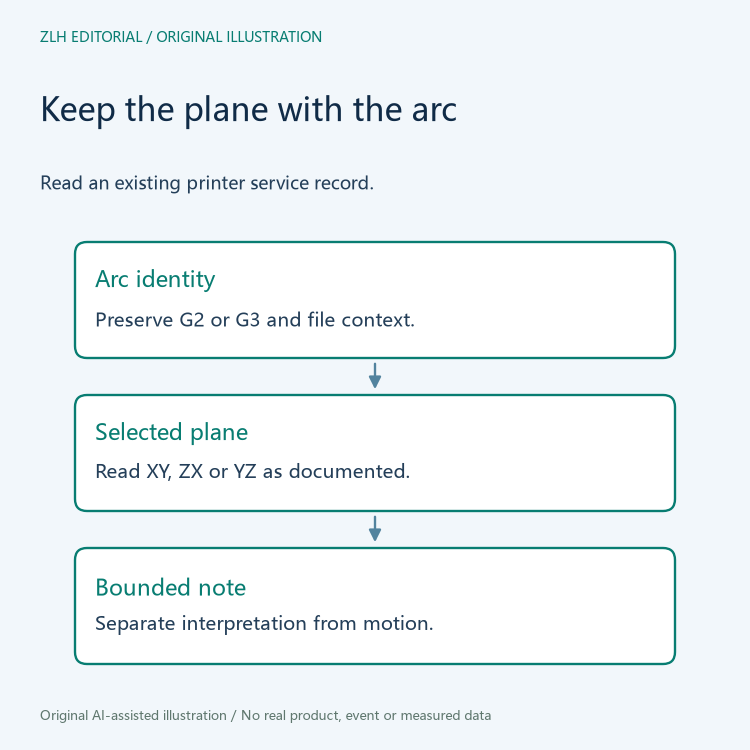
A printer service appendix may contain Arc Records labelled clockwise or counter-clockwise and a sketch drawn on an XY grid. The sketch can conceal a missing assumption: which workspace plane the file declares. Marlin's G2/G3 and G17-G19 references connect arc interpretation with the selected XY, ZX or YZ plane when the corresponding feature is supported. A document reviewer should preserve both the arc direction and the plane context before treating an illustration as a faithful explanation of a supplied file.
Read the arc word and the plane as separate parts
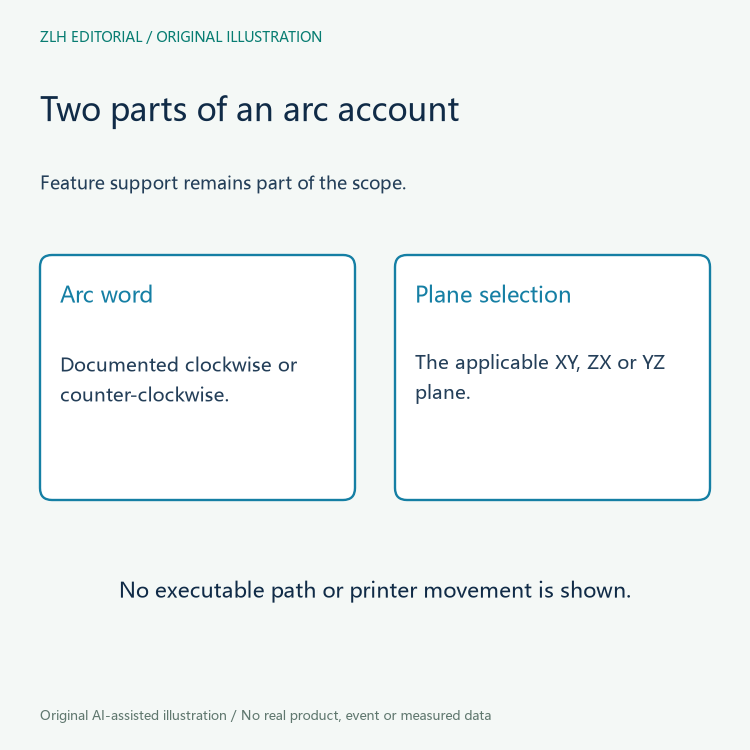
The official arc page describes G2 as adding a clockwise arc move to the planner and G3 as adding a counter-clockwise arc. Its plane discussion says that CNC_WORKSPACE_PLANES permits operation in a selected XY, ZX or YZ plane. These statements answer connected but different questions: the arc word supplies the documented direction, while plane selection supplies the workspace plane in which the interpretation applies.
Consequently, an isolated G2 or G3 label does not justify adding an XY caption from memory. A service reader should retain the surrounding file context that explains the active plane. This article reads existing records and public definitions only. It creates no executable path, sends no G-code and does not move, heat or otherwise operate a printer.
Keep the three plane names in the documented order
The workspace-plane reference associates G17 with XY, G18 with ZX and G19 with YZ. The ordered plane labels should be retained as the source states them. Replacing every plane with an informal horizontal or vertical description can discard the axis identity, particularly when an attachment changes viewpoint or uses a simplified diagram.
The two pages also identify feature conditions. The arc page names ARC_SUPPORT, and the workspace page explains its CNC_WORKSPACE_PLANES condition. A public command description is therefore not proof that every unknown firmware build accepts every listed plane-related behavior. If the service packet omits its firmware configuration, the reviewer should identify that missing context instead of declaring a command unsupported or operational from the syntax alone.
Starting context remains part of the supplied arc account
The arc reference describes a move beginning from the current position and ending according to supplied coordinates and center or radius information. That makes a cropped line a limited excerpt. Even after the plane label is understood, the reviewer should not invent the omitted starting context or reconstruct a complete trajectory from a caption. The arc's record identity and the preceding material matter to the reading.
The same principle applies to the center representation. The reference documents distinct forms and conditions for the parameters it describes. This article does not turn those forms into a new example program or select numeric values for a machine. Its purpose is to ask whether a contributor's explanation retains the information needed to understand their existing record.
The arc page also explains that arc moves generate a series of short straight-line moves, with segmentation governed by firmware configuration. A line containing an arc word is therefore a command-level description, rather than an independent log of every physical step taken. Preserve that representation boundary in a repair appendix. A corrected plane caption can clarify how the command is read, while the firmware's actual planning context and any observed movement still need their own supporting records. No segmentation setting is recommended or changed here.
Resolve a fictional sketch mismatch without diagnosing motion
Suppose a fictional repair folder has a plane-selection note identifying ZX, while an editorial sketch is captioned as an XY arc. The immediate document question is whether the sketch intentionally shows another view or accidentally uses a different plane. A reviewer can request that explanation and preserve the original file context. Nothing in the fictional folder proves that the printer executed an incorrect movement.
If the contributor supplies a corrected drawing, the note can say that its axis labels now correspond to the declared interpretation. It should not announce that a path was executed, a motion defect was repaired or a printed surface was verified. Those would require actual observation records beyond the two reference pages. This example includes no machine coordinates, generated path or observed print.
Hand over a plane-aware record note
A useful service note identifies the original arc word, the stated active plane and the applicable firmware context. It distinguishes a source interpretation from a drawing or a claimed observation. If the appendix lacks the context that determines the plane, leave the interpretation bounded rather than silently assigning one. A familiar-looking arc diagram is not a substitute for that missing record.
Further reading appears in the site's printer service file collection and G-code reading notes. Arc direction and workspace plane should travel together through a summary, while actual printer behavior remains attached to its own evidence. This keeps a documentation correction useful without turning it into a new operating instruction.
Primary references: Marlin CNC Workspace Planes; Marlin Arc or Circle Move.


