

Printer Coordinate Records: XYZ Mode and Extruder Override
2026-11-05
Printer Coordinate Records: XYZ Mode and Extruder Override
Printer Coordinate Records need to preserve which axes a mode statement concerns. In Marlin, an extruder-specific override is not the same statement as the general positioning mode for the other axes. A repair attachment that compresses every mode reference into “absolute” can lose that distinction. This article reads existing-document semantics only. It sends no G-code, edits no file, heats no extruder, and moves no printer component.
General positioning concerns the logical coordinate space
The official G90 reference describes interpreting coordinates as positions in the logical coordinate space in absolute mode. It includes the extruder position unless an E-specific relative override applies. A reviewer should retain the logical-coordinate qualification rather than treating a displayed value as a direct measurement of a mechanical position.
In a hypothetical service appendix, a contributor may annotate a retained program fragment with a general mode description. Ask which part of the fragment that description covers and whether the surrounding context is supplied. A single mode label does not identify all later interpreter state. It also does not prove that any attached program was executed on the reported device.
The E-axis overrides have a narrower scope
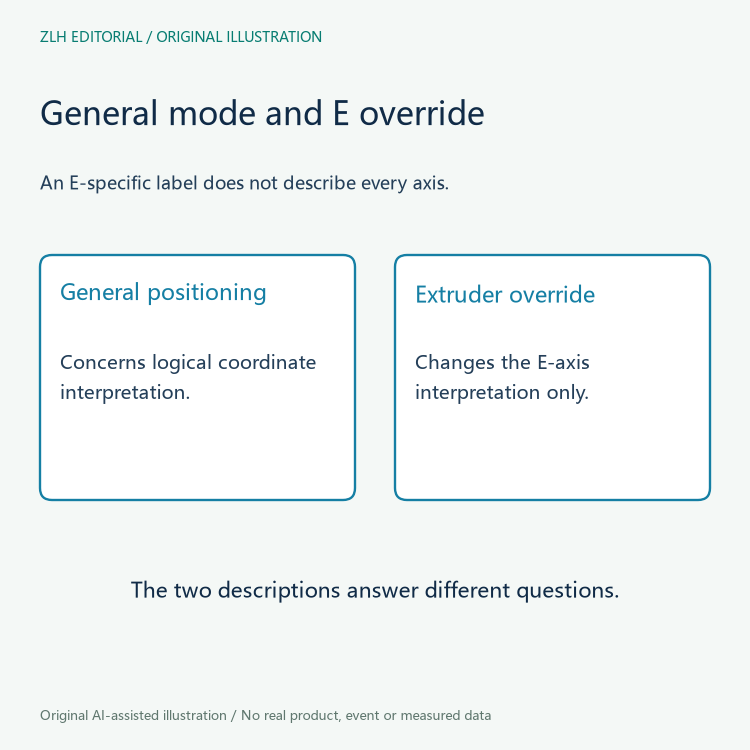
The official M82 reference describes placing E in absolute mode independently of the other axes, overriding the general relative mode for that axis. The official M83 reference describes the complementary E-specific relative override. Their descriptions identify a narrower axis scope than a blanket statement about every coordinate in a file.
For a fictional retained fragment, an E-specific relative description does not establish that X, Y, and Z are also relative. Conversely, a general absolute description should not be used to erase a documented E override without the relevant sequence context. This article supplies no example command sequence and does not calculate extrusion or movement amounts.
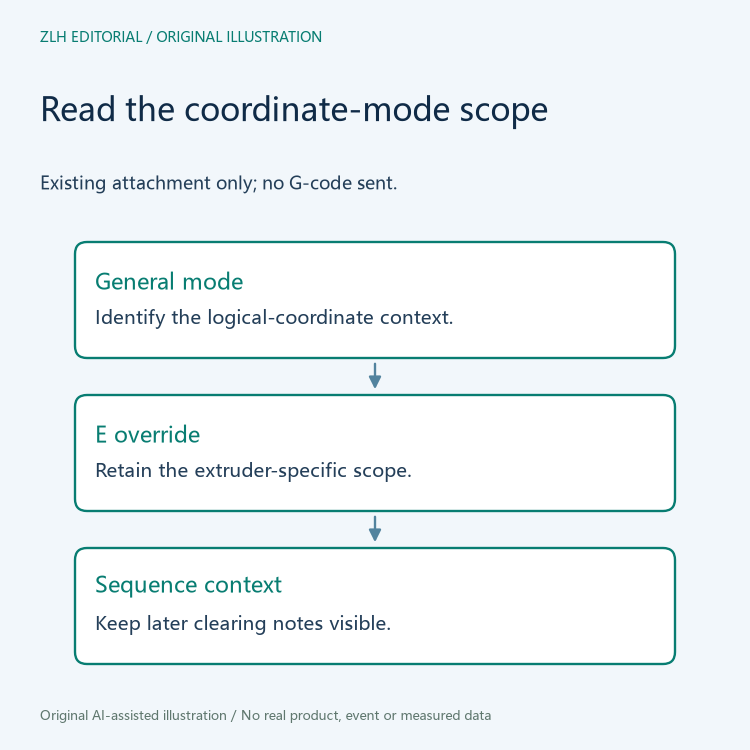
Retain the notes about clearing an override
Both E-mode reference pages explicitly note that G90 and G91 clear the described override. This prevents a summary from treating an E-specific setting as independent forever, regardless of later general mode statements. An existing log needs enough ordering context to support its interpretation. Do not combine lines from different captures into a sequence the source never supplied.
A useful hypothetical review can identify the retained fragment, source firmware documentation, general-mode statements, and E-specific statements separately. If the fragment begins after an unknown earlier state, say so. A reader should not invent a missing setup solely to make the fragment easier to explain. The article does not resolve the interpreter state of a real file.
Keep interpretation distinct from the service outcome
Correctly naming an axis scope is a documentation improvement. It does not establish that an extrusion problem was repaired, that a quantity was deposited, or that a printed part meets a requirement. Those are different claims needing their own observations. An attractive model preview cannot stand in for the missing mode context of an interpreter record.
Document versions also matter. This discussion follows the cited Marlin pages, not an assumption that every printer firmware uses identical clearing rules. If an attachment concerns a different interpreter or a modified build, request the applicable material. A familiar code name is not enough to transfer all behavior from one implementation into another service report.
When a contributor corrects the annotation, record what changed. A revised sentence about E scope is not necessarily a revised G-code file. A newly supplied file should have its own identity, and a newly supplied execution record should retain its own capture context. Do not let one “fixed” label imply that all three objects changed together.
The service question can be precise without becoming an operating instruction: which axes does the supplied mode explanation describe, and what later retained statements affect it? If the evidence cannot answer, leave that uncertainty in the intake. This helps a technician understand the documentation gap without asking the reader to recreate motion or test an unknown file.
The axis name is especially important when the same attachment mixes explanatory prose with excerpts. A phrase such as relative extrusion should remain attached to E, while a phrase about general positioning should preserve its broader context. If a contributor has shortened those descriptions for a table heading, ask it to restore the missing scope. Clarifying the heading is a documentation task and does not authorize altering the retained interpreter input.
The original illustrations show a reading sequence and compare general with E-specific scope. They contain no executable fragment, extrusion value, or measured result. Continue through the printer service documentation section and related resources section. Preserving mode scope and ordering makes a coordinate appendix more useful while keeping physical diagnosis and repair completion attached to actual service evidence.


